Standard Trigonometric Equations
What you will get from this section. We will start with the circle definition of the trigonometric functions, establish three basic properties of sine, and use them to find every solution of a sine equation. The examples then show how the same reasoning extends to equations with trigonometric expressions on both sides. Cosine and tangent have analogous results, which we will state at the end.
In this article, I am deliberately revisiting a familiar A-level topic, developing it from the basic definitions rather than simply quoting results without fully explaining them. My aim is to show what a thorough understanding of even a basic topic can achieve, and how this depth of understanding can greatly simplify some TMUA questions.
TMUA Relevance Score: 8/10
Defining the trigonometric functions
Consider a circle with centre and radius . Starting at the point on the positive -axis, rotate a point through an angle around the circle. Positive angles represent anticlockwise rotation, while negative angles represent clockwise rotation. We may also make any number of complete turns.
Suppose the coordinates of after this rotation are , as shown below.
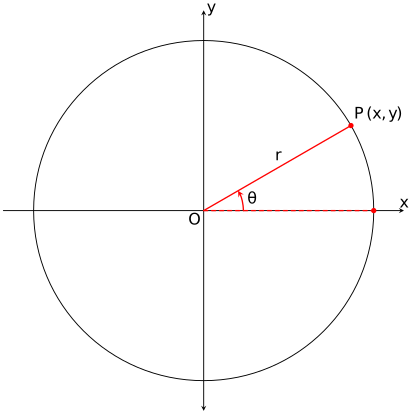
We define
These definitions give sine and cosine for every real angle , and tangent whenever . For acute angles, they agree with the familiar trigonometric ratios in a right-angled triangle.
Throughout this article, angles are measured in degrees. The results are, of course, equally valid in radians, with the angles converted accordingly.
Three basic properties of sine
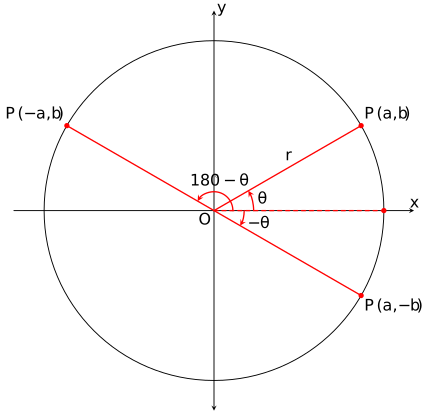
Let the point corresponding to now be labelled , so that . The diagram below shows this position together with the positions corresponding to and . Each is a possible position of the same moving point .
Property 1: Periodicity
Starting from , any number of complete turns in either direction returns us to exactly the same point. Each additional rotation through or is a complete turn, so it leaves in the position reached after the original rotation through . Therefore,
Property 2: Reflection in the -axis does not change the sine
The point corresponding to is the reflection of in the -axis, so its coordinates are . Its vertical coordinate is unchanged. Hence
Property 3: Reversing the angle changes the sign of the sine
The point corresponding to is the reflection of in the -axis, so its coordinates are . Therefore,
or, equivalently, . This is the statement that sine is an odd function.
Although the diagram shows an acute , none of these arguments requires it to be acute. The same rotations and reflections apply wherever lies on the circle, so all three properties hold for every real .
Basic properties. For every real and every integer ,
A motivating example: solving graphically
Consider the equation . We can solve it graphically by finding the intersections of the curve and the horizontal line .
The graph below shows the sine curve in red and the horizontal line in blue. The horizontal axis is measured in degrees.
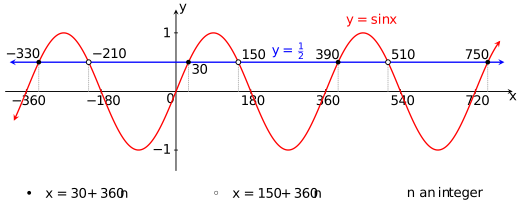
In the interval , there are two intersections, at and . These exact values agree with the familiar results .
However, the sine curve continues in both directions, repeating every . Each of these two intersections therefore repeats after adding or subtracting any multiple of .
The filled circles show the family
while the hollow circles show the family
We can describe these two infinite sets compactly:
Every intersection belongs to one of these families, so together they give all solutions of . This example illustrates how a seemingly simple equation can have two infinite, periodic families of solutions.
It turns out that we can use the basic properties of sine to find these general solutions purely algebraically. Combined with some familiar trigonometric identities, this approach can greatly simplify some tricky trigonometric equations.
Standard sine equations and their general solutions
By a standard sine equation, we mean an equation of the form , where , and are real constants and . Here and are coefficients, not the coordinates used in the circle diagram. The expression is the whole angle being passed into sine.
We will now use the basic properties to establish the following equivalence entirely algebraically.
For all real , , and , with , and every integer ,
Proof
Property 1 gives
Combining Properties 1 and 2 gives
All three expressions therefore have exactly the same value. Consequently, the original expression equals if and only if either transformed expression equals , proving the equivalence.
Notice that we made no assumption about . The argument applies unchanged when or . It also applies when or : in those cases, all three equations have no real solutions for because sine always lies between and .
A practical general solution for
Suppose now that , so that exists. This gives the unique angle in whose sine is , called the principal value. It does not mean a reciprocal.
Starting from this angle and applying Properties 1 and 2 gives two families of solutions:
Set 1: .
Set 2: .
In each family, may be any integer. Since integers can be positive or negative, writing alone describes the same family as .
We have found two families of solutions. The graph in our motivating example suggests that these should account for every solution, and this is indeed the case. A rigorous proof that there are no other solutions is possible, but we omit it to keep the article brief.
When or , the two families describe the same set of solutions, as expected. If or , the original equation has no real solutions, and the real inverse sine is undefined.
These formulas provide a simple practical algebraic method: subtract , divide by , and keep only the values of in any specified interval. Remember to divide the period term by as well.
You might wonder: how useful is all this? After all, these standard equations are... standard, and they look rather simple. 🤔 Well, firstly, they can be made to look far more menacing than they really are. Secondly, an otherwise very tricky trigonometric equation can sometimes be transformed into a standard one—and then your hope for a simple equation may come true after all. 😎 As the examples below will demonstrate.
Example 1: A standard sine equation
Solve for .
Example 1 solution
Since , direct application of the practical general solution gives
Subtracting and dividing by gives
Therefore, the solutions in the specified interval are .
The algebra is direct — the abstraction means you barely have to think about anything geometric or graphical.
Example 2: Sine expressions on both sides
Solve for .
Example 2 solution
This time, the right-hand side is already a sine expression. In one respect, this is actually simpler: we do not even need to evaluate an inverse sine! We can use as our starting angle and apply the same two families directly:
Simplifying and making the subject gives
Therefore, the solutions are .
And that's it — unceremoniously solved! No hard graphical or geometrical thinking required.
Example 3: Transforming cosine into sine
Solve for .
Example 3 solution
This equation looks rather more menacing because it contains both sine and cosine, together with a negative sign. However, recall the familiar GCSE identity
Combining this with Property 3 allows us to rewrite the left-hand side:
The original equation is therefore equivalent to
We are now in exactly the same situation as Example 2. Applying the same general result gives
Simplifying and making the subject gives
Therefore, the solutions are
And there it is: after applying two basic identities, this rather menacing trigonometric equation has become two ordinary linear equations. Our hope of a simple equation has come true! 😎
Example 4: A modulus, twenty solutions, and one short sum
Find the sum of all distinct solutions of
in the interval .
Example 4 solution
A modulus inside sine, cosine on the other side, and an interval covering four complete turns. Drawing the graphs accurately would be quite a task! Instead, we will use our general solutions to turn the equation into very ordinary algebra.
First, write . The expression inside the modulus changes sign at , so we consider two cases.
Case 1:
Here , giving
Our general result gives
Rearranging, and reindexing where convenient, gives
But the second family is already contained in the first, because
It contributes no additional solutions.
We therefore need only the members of
that satisfy .
There are no solutions between and , and the first positive solution is . Since and , the allowed indices are . There are exactly ten solutions: an arithmetic sequence starting at , with common difference .
We may or may not need to enumerate them. Let's check out Case 2 first!
Case 2:
Here , giving
Our general result gives
Rearranging gives
This time, the first family is already contained in the second: , and is a multiple of . Again, it contributes no additional solutions.
We therefore need only the members of
that satisfy .
The solution closest to zero is . Counting downwards in steps of , the allowed indices are again . There are exactly ten solutions: an arithmetic sequence starting at , with common difference .
Sum without enumeration
We now have two arithmetic sequences, each containing ten terms. Their common differences are opposite, so pairing corresponding terms gives
There are ten pairs. Therefore, the required sum is simply
There are other ways to tackle this question, but this method is particularly efficient: our practical general solutions turn a potentially messy graphical problem into manageable algebra, and a simple pairing observation finishes the job!
Summary
Cosine and tangent have analogous results, proved in similar ways. To keep this article brief, we omit those proofs. Equations involving cosine, tangent or angles in radians can be approached in the same way. The results are collected below; for radians, replace with and with .
Basic properties
Here , and the identities apply wherever the functions are defined.
Function Periodicity Supplementary angles Negative angles Sine Cosine Tangent
General solutions
Here and . The inverse functions use their principal values: , and . If is outside the stated range, there are no real solutions.
Equation Condition General solutions or or